Monday, January 11, 2010

Vocabulary Mini Office


To be honest, I struggle with the concept of teaching vocabulary. Some teachers feel that teaching traditional vocabulary lessons are the way to improve a child's spoken or reading vocabulary, and others believe that simply reading good books will provide this improvement to the child's word base. I have used both approaches and see the advantages to both. I believe that traditional vocabulary lessons may not provide the crossover knowledge that we desire, but it does provide other areas of learning. These lessons help train the child in alphabetizing, dictionary skills, and discernment. I feel that all of these are important skills for children. After much back and forth, I have decided to create a Vocabulary Mini Office for my children using the Four Fold Vocabulary Method. I found this method and a wealth of others at this site: http://www.cobbk12.org/Cheathamhill/LFS%20Update/Vocabulary%20and%20Word%20Walls.htm .

The idea behind the Four Fold Method is that the student folds their papers into rows of four sections each. In the first section, the student writes the word. In the second section, the student writes a definition of the word in their own words. In the third section, the student draws a picture or symbol to represent the word. In the final section, the student writes a sentence with the word based on their definition.

After completing this, I have my kids place the sections into pockets in their mini office. They must review the cards daily as part of their vocabulary study. Eventually, I would like for them to cut apart the sections and play a matching game.

My children actually think this is a fun activity!:) I even let them decorate the outside of their office.

I found a few good sites while on my quest for direction in the realm of vocabulary and I hope they prove helpful:

http://www.teach-nology.com/worksheets/language_arts/vocab/five/
http://www.tampareads.com/wrksheet/index-4b.htm
http://www.vocabulary.co.il/
http://treasures.macmillanmh.com/georgia/teachers/resources/grade3/spelling-and-vocabulary-activities
http://www.proteacher.com/cgi-bin/outsidesite.cgi? id=12912&external=http://www.factmonster.com/cgi-bin/word&original=http://www.proteacher.com/070169.shtml&title=Word of the Day
http://www.perucsd.org/claundree/3rd%20grade%20spelling_words.htm
http://www.vrml.k12.la.us/cc/vp_gle/2nd/ela/trophy/2nd/speed_read/speed.htm
http://www.teach-nology.com/worksheets/language_arts/vocab/third /
http://www.vocabulary.com/

Monday, January 4, 2010

World Geography

Our co-op has decided to do a World Geography class this semester. Personally, I love learning about new places and am very excited about this class. It is my hope that the kids will find it interesting and fun. Here is a sample of the lessons that we will be doing:

Central and South America
1. Welcome to Central and South America! How long do you think it would take to get to one of these countries by plane? By car? By foot?
2. What do we already know about this area of the world? Teacher should list students’ comments on the board as they offer them.
a. Language
b. Religion
c. Politics
d. Food
e. Education
f. Traditions
3. Let’s see if we can learn new things about our neighbors! Pass out the outline map of Central and South America. Have students fill in the country names and color each country a different color. Point out interesting countries and facts about them as you discuss. For example: Panama/Panama Canal, Ecuador/Galapagos Island, and Brazil/Amazon River.
-Have the students make a special color for these areas on their map.
4. Are there any interesting land forms in this area of our world that make it interesting? South America has some of the highest mountains (outside of Asia) in the world: Consult http://www.scaruffi.com/travel/tallest.html. It also has some of the longest rivers in the world: Consult http://www.socialstudiesforkids.com/articles/geography/longestriverstable.htm . They also are home to some of the rain forests of the world: Consult http://www.srl.caltech.edu/personnel/krubal/rainforest/Edit560s6/www/where.html .
Central (Mesoamerica) and South America
1. Angel Falls- highest free flowing waterfalls in the world
2. Atacama Desert- one of the driest deserts on Earth
3. Amazon River Delta- largest Aquifer in the world
4. Amazon Rain Forest- provides largest amount of timber and medicinal plants
5. Chile- largest producer of fruits and vegetables to North, South and Mesoamerica
6. Tierra del Fuego- most southern tip of South America in Argentina, closest land to Antarctica
7. Patagonia- sparsely vegetated plains in southern portion of South America in Chile and Argentina
8. Andes Mountains- highest mountain range in western hemisphere, site of the 1972 plane crash with Rugby team, longest exposed mountain range in world.
9. Panama Canal- Completed by United States and Panamanian Government in 1914, it saves over 18,000 miles by water to go from New York to California.
10. Called Latin America because all of the non-native, spoken languages are derived from Latin. Calling someone Hispanic is actually not appropriate because to be Hispanic you must come from the island of Hispaniola (Haiti and Dominican Republic). There are several different dialects of Spanish spoken in Central and South America and a Spanish speaker from Chile or Argentina would have a very difficult time communicating with a Spanish speaker from Cuba.

5. Have the students create a map key with distinctions for each of these and illustrate them on their map as well.
6. Let’s take a look at another important part of Geography- “Human Movement” (Natural Resources). Where do the products we use originate? Invite students to collect labels from foods, clothing, toys, and other products they use. Where do those products come from? What percentages of those products are made in your state? Your country? Other continents? Are we dependent on products from all around the world? Talk about how products made outside your community might get there. Now that we have an idea of what Central and South America looks like, let’s see what natural resources they have to offer.
a. Central America has natural resources of copper, gold, silver, and zinc.
b. South America has natural resources of coffee beans, cocoa beans, bananas, timber, rubber, gold, bauxite, spices, and salt.
7. Have students incorporate their maps and a list of natural resources into their travel guide for Central and South America.


After this introduction to the Continent, we will then discuss the culture of the region and focus on a holiday from this area while comparing it to the US. For example, while we are studying Central and South America we will look at the Carnival celebration in Brazil and how does that compare to the US celebration of Lent. As a follow up to the culture discussion, we will have the students create a craft from this area of the world. For Central and South America we will create maracas!

As a culmination of the area study of Central and South America, we will ask each student to bring in a dish native to this area and the class will participate in a International Food Court. I think that the kids will love this! After the kids dig in, we will have a guest speaker from this region discuss their culture and homeland with the kids. I am blessed to have great friends from the three regions that we will be learning about (Africa, Central and South America, and Asia) that will be our speakers! I am very excited to hear what they have to share.

I always want my children to have something tangible to bring home from their classes and this is no different. I have created a Travel Guide for the students to create in conjunction with what they are learning in class. I have uploaded the file to HS Launch for others to download. I am hoping that the kids will enjoy choosing pictures from the region to included in their guide and sharing them with their class.

While doing my research for this curriculum, I have come across a few great geography sites that might be helpful if you are studying this subject.

http://www.learningtreasures.com/geography.htm
http://www.cloudnet.com/~edrbsass/edgeography.htm
http://www.mandarintools.com/chinesename.html
http://www.ibike.org/library/africakids.htm
http://www.africaguide.com/cooking.htm
http://family.go.com/food/article-224973-asian-recipes-t/
http://www.wisedude.com/misc/continents.htm
http://www.homeschooling-ideas.com/geography-activities.html
http://player26.narrowstep.tv/nsp.aspx?player=globe_trekker&ref=pilot_web
http://indianchild.com/Recipes/indian_recipes_index.htm
http://www.africaourafrica.com/content/Interesting-places-in-Africa?page=1
http://www.homeschooling-ideas.com/kids-geography.html
http://www.mapmsg.com/games/statetris/usa/
http://www.postcrossing.com/
http://www.sheppardsoftware.com/South_and_Central_American_Geography.htm
http://www.ilike2learn.com/ilike2learn/Samerica.html
http://www.travelforkids.com/
http://www.eduplace.com/ss/maps/
http://www.worldatlas.com/webimage/testmaps/maps.htm
http://www.edupics.com/en-coloring-pages-pictures-photo-geography-c143.html
http://www.tlsbooks.com/geographyworksheets.htm
http://www.homeschoolblogger.com/uploads/j/jacaud/105960.pdf
http://www.gamequarium.org/dir/SqoolTube_Videos/Social_Studies/Geography/
http://teacher.scholastic.com/activities/globaltrek/
http://www.homeschoolshare.com/country_lapbook.php
http://www.nationalgeographic.com/resources/ngo/education/ideas.htmlv
http://kids.nationalgeographic.com/Places/
http://www.travellerspoint.com/pcindex.cfm
http://www.homeschoolinthewoods.com/WebLinks/weblinks-geographygeology.htm
http://www.squidoo.com/JapanUnitStudy
http://tagfoot.com/jimmie/bookmarks/geography
http://www.squidoo.com/MexicoAdventure

Okay- so it is a lot of web sites!:0) I do not know when to stop!


I hope that you enjoy your study!

Friday, December 25, 2009

Zoology Notebook

It is Christmas day and I am just finishing up creating a Zoology Notebook for my kids to work on next semester. I enjoy reading the Apologia Science books and think that the note booking aspect of the books is very kid-friendly. My kids love animals and I honestly cannot wait to get started on Zoology because I know they will just love it!

We are planning a trip in January to our local Aquarium and one in May to our local Zoo. I am hoping that the trip to the Zoo will be especially meaningful after our Zoology study.


I have uploaded my Zoology Notebook to HSLaunch for anyone that could use it. Here are other good resources that could be useful:

http://www.learningtreasures.com/animal_classification.htm http://www.learningtreasures.com/make_an_animal_notebook.htm
http://www.gamequarium.org/dir/SqoolTube_Videos/Science/Animals/
http://www.jeanniefulbright.com/notebookpages.html
http://www.naturedetectives.org.uk/club/
http://www.learningtreasures.com/classification_class.htm
http://www.scribd.com/doc/6759218/African-Animal-Note-Booking
http://www.mbgnet.net/ http://www.homeschoolshare.com/animal_classification_lapbook.php
http://www.homeschoolshare.com/animal_classification_system.php
http://www.animalcorral.com/
http://www.thetoymaker.com/Toypages/49Animals/49Animals.html
http://www.sheppardsoftware.com/content/animals/kidscorner/gamesforkids.htm
http://kids.nationalgeographic.com/Animals/
http://video.nationalgeographic.com/video/player/kids/animals-pets-kids/amphibians-kids/
http://www.apples4theteacher.com/hangman.html
http://learningtreasures.com/wordpress/homeschool-helps-animal-notebooks-what-to-do-next
http://education.sdsc.edu/download/enrich/make_a_frog_book_pg_1.gif
http://www.jdp.co.uk/
http://www.sheppardsoftware.com/content/animals/kidscorner/kidscorner3.htm
http://www.albright-news.com/Lion-Lapbook.htm
http://www.zooatlanta.org/home/kids_corner
http://tagfoot.com/jimmie/bookmarks/habitats
http://www.zoobooks.com/virtualzoo.aspx?n=546584


I hope that you will enjoy these sites!

Tuesday, December 1, 2009

Jesse Tree

I first heard about the concept of a Jesse Tree last year before Christmas and thought that it sounded fun. I am always looking for ways to help my kids understand the meaning behind Christmas and this seemed like a good way to do that. As I understand it, the Jesse tree is a daily devotional that takes the reader through the lineage of Jesus culminating in his birth. Each devotional day has an ornament to correlate with it that the kids can color or create and hang on a Christmas tree.

Here are some devotional sites that are helpful:
http://www.eriercd.org/pdf/reflections.pdf
http://www.jesse-tree.com/jesse_tree.html
http://www.rca.org/Page.aspx?pid=1628
http://www.jesse-trees.com/parent/parent-devotions.html - parent devotions


I purchased my twleve day devotional set from Illuminated Ink. The ornaments that we used were ones that my kids took turns coloring and cutting out. They ended up being three dimensional and the kids loved them. They were so excited when I pulled them out again this year.

Here are a few sites about making the Jesse Tree:
http://www.shalfleet.net/advent/makeajessetree.htm
http://www.catholicculture.org/culture/liturgicalyear/activities/view.cfm?id=545
http://www.kingofpeace.org/resources/ - Scroll down for ornament templates
http://www.rca.org/Page.aspx?pid=1625

Free Printables:
http://www.osv.com/Portals/0/images/pdf/JesseTree.pdf
https://www.pcusa.org/advent/pdf/advent-eng1.pdf - printable ornaments with instructions
http://www.kingofpeace.org/advent/advent.htm
http://www.jesustreedecorations.com/html/descriptions.html


I hope your kids have as much fun as mine are having!

Sunday, October 25, 2009

Spider-Man Lapbook


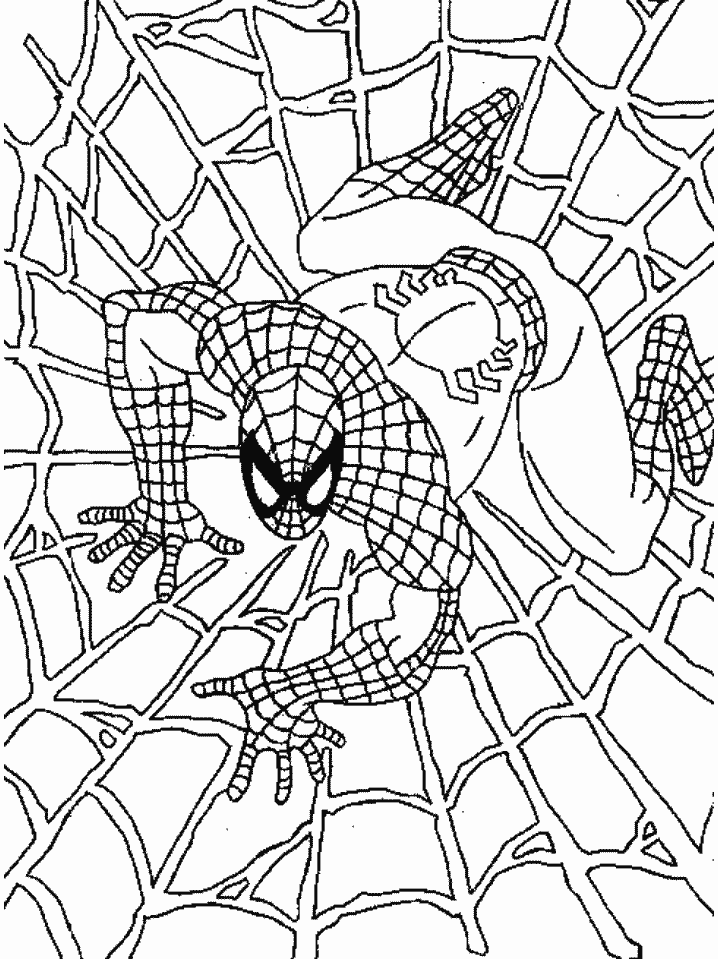
My youngest is currently interested in Spider-Man and wanted mom to create a Spider-Man lap book. At first, I was concerned because what educational value could Spider-Man possibly have? But, after doing a bit of research I found a great deal of educational elements that I could look at with my son.


The first, most obvious, direction was the origin and creation of comic books. It was actually quite interesting how they got their start. I made mini books on the origin of comic books and a vocabulary book for the different parts of the comic book and one on the different jobs it takes to make a comic book. I also made a book on New York City because this was the setting for the Spider-Man story.


Of course, I had to make a few books that were specific to Spider-Man. I created mini books on Spider-Man's "villains", his "partnerships", and his "abilities and weakness". My son used one of his many Spider-Man to fill in this information. He had a great time showing me all of his "Spider-Man Knowledge"!


I found a number of great web sites with information and two that my son really enjoys because they allow him to create his own superhero and his own comic book.


Wednesday, October 21, 2009

Botany Notebook


We decided to do Apologia Botany this year for our science class. I really love Apologia mainly because I can use it with all three of my children at one time. I decided to create my own Botany Notebook to go along with the note booking activities that Mrs. Fulbright details in her chapters. We have been working through the notebook so far this year and it is working beautifully.


To supplement, I added a lap book of Carnivorous Pants from Dynamic2Moms. It was really well made and interesting for the kids. I even bought a Venus flytrap from our local nursery so the kids could watch science in action!:) I actually caught a fly in my house and fed the plant so the kids could see how it traps the insect. It was really fun.


I also thought that it would be a great idea to go to our city's botanical gardens. I set up a field trip to go and it ended up being a gorgeous day. I made the kids find four of their favorite plants/flowers and I took a picture of the child with each plant/flower. I plan for them to include these pictures in their botany notebook. My favorite part of the botanical gardens was the orchid exhibit. It is amazing the diversity of these flowers! My children's favorite part of the gardens was the Venus flytraps and pitcher plants.

Here are a few of the great web sites that I found when compiling my materials for this study:
http://www.fs.fed.us/r6/uma/urban/ -wildflower coloring book

Monday, October 19, 2009

Fall Bridal Shower Decor

I am including this on my blog because when I was looking for ideas to use while decorating for a bridal shower, I could not find anything online. I used just about everything I could find around my house for decorating the table scape. Lucky for me, majority of my color scheme in my house is fall-like colors: yellow, burgundy, and brown.


The table scape was easy to create with a few shoe boxes and a chocolate brown flat sheet that I had on hand. A few years ago I was on a pumpkin bent so I have a lot of fake pumpkins of various sizes and colors. I coupled these pumpkins with candles that I already had for added atmosphere around the table. I must give a lot of the credit to my Mother-in-law because she is a genius with putting things together and really has unbelieveable vision.


As you can see, I found a bag of raffia and went a little crazy with it. I found myself puttingit on everything!:)


I grabbed two pumpkins at Wal-Mart for around $4 each and two containers of mums that are HUGE for $12 at the grocery store. I plan to carve the pumpkins with the kids when it gets closer to Halloween, and the mums will give my porch nice color for a few weeks at least.


All in all, it was a nice shower decor and fairly cheap to pull off.